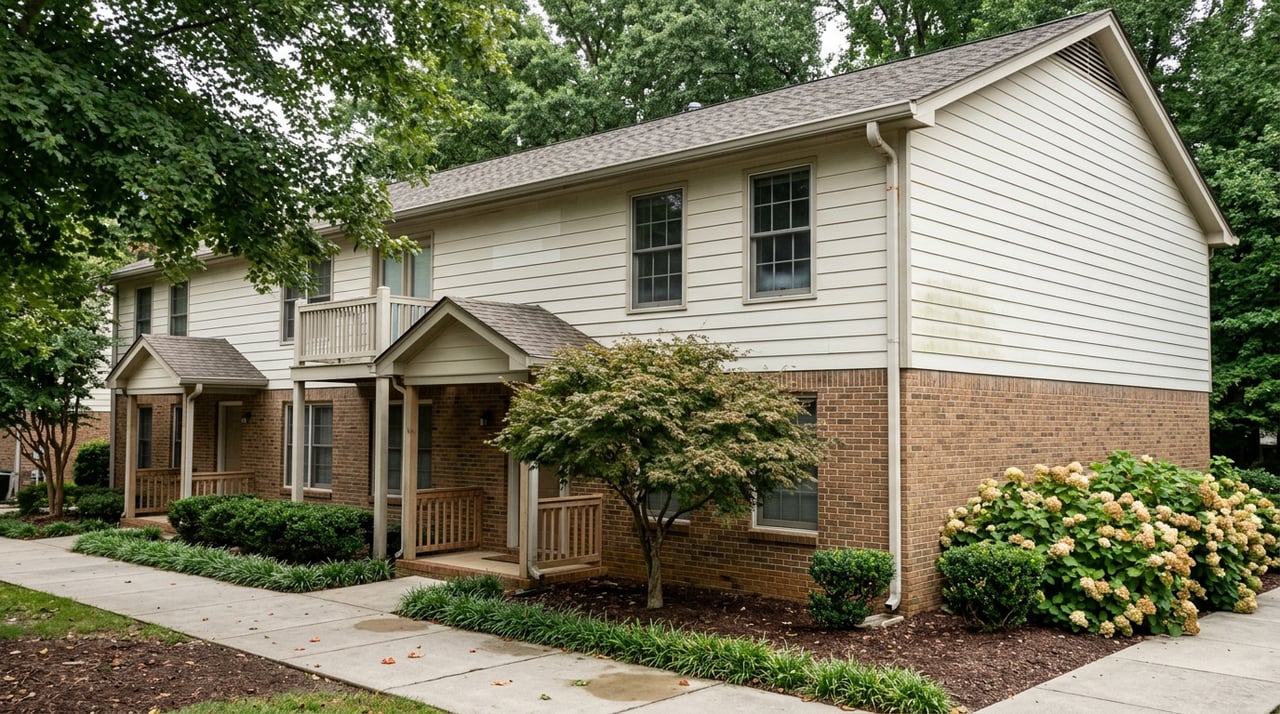
Somewhere on a Green Hills resale certificate this year, a buyer will find two numbers that used to travel together and no longer do. The first is the monthly HOA fee, printed cleanly on the listing sheet, the figure every condo shopper uses to compare one building to another. The second sits lower on the page, in a line most people skim past: a special assessment, stacked on top of the regular fee, covering a repair the reserve fund wasn't ready to pay for outright. At Hillmont Condominiums on Woodmont Boulevard, that second number has run $160 a month, added to a base fee that already sits between $300 and $500, to finish paying for new Hardy-board siding the association is still working off through 2026.
That gap between the advertised fee and the actual monthly cost is exactly what Tennessee lawmakers set out to close. What they built, though, closes only half the problem, and understanding which half matters more to a buyer writing an offer than to the legislature that passed the bill.
The Resale Certificate Now Has to Say More
When a Green Hills condo goes under contract, the seller or the association's management company prepares a resale certificate, a packet of financial and governance information the buyer is entitled to before closing. Tennessee law gives associations up to ten business days to produce it, and the cost of preparation, typically $150 to $500, usually falls to the seller. The certificate has always covered the basics: current assessments, any delinquencies, whether the board is still under the original developer's control.
What changed is what it now has to say about reserves. A buyer requesting a resale certificate today is entitled to know whether a reserve fund exists, how much is in it, and whether a professional reserve study backs up that number. That last piece did not used to be guaranteed. Now it is, at least for the buildings the law reaches.
The Law Behind the New Line
The requirement traces to Public Chapter 205, signed by Governor Bill Lee on April 23, 2023, which added a new subsection to Tennessee's Condominium Act. It applies to any condominium association whose board oversees common elements with an aggregate replacement cost above $10,000, which in practice covers nearly every multi-unit building in the state. Associations that had not conducted a reserve study since January 1, 2020, had to complete one by January 1, 2025. Buildings with a more recent study simply update it, and every board has to update its study at least once every five years going forward.
The statute is specific about what a real study has to examine: the roof, load-bearing walls, the foundation, fireproofing and fire protection systems, plumbing, electrical systems, waterproofing and exterior painting, balconies, elevators, and any other component whose deferred maintenance would run past $10,000. A qualified engineer, architect, or contractor has to sign off, not a board member with a spreadsheet.
The rule exempts a board still controlled by the declarant, a condominium titled to a single owner, and a condominium held by a husband and wife as tenants by the entirety.
That exemption matters for a Green Hills buyer mainly at the newest end of the corridor, in any building still working through its initial developer-controlled phase. Everywhere else, the study requirement applies, and once it's done, the board has to post it or email it to owners.
A Study Is Not the Same Thing as a Funded Reserve
Here is the part the law does not do. It requires the analysis. It does not require the association to follow it. Tennessee sets no minimum reserve balance and no funding formula. A board can commission a study, learn that the roof needs $400,000 in six years, and still choose to keep dues flat and cross that bridge later. The statute asks the board to review funding adequacy annually, but adequacy is a judgment call, not a number written into the code.
That is the mechanism worth sitting with before you compare two Green Hills buildings by their listed HOA fee alone. A lower fee can mean genuinely lower costs. It can also mean a board that has looked at its own reserve study and decided not to fund it, which shows up later as a special assessment rather than a monthly increase, the way it did at Hillmont. The paperwork the new law requires tells you a study exists. It does not tell you whether the board acted on what the study found. Reading the study itself, not just confirming its existence, is the only way to know.
Twelve Buildings, Four Decades of Systems Wearing Out
Green Hills carries an unusually wide range of condo vintages for one corridor, and vintage is the plainest predictor of which buildings are approaching a major capital cycle regardless of what any study says.
| Building | Year Built | What the Age Signals |
|---|---|---|
| Georgetown | 1969, second phase 2007 | Oldest structure in the corridor, deepest closed-sale history, original systems from the 1969 phase are well past a typical service life |
| Four Seasons of Green Hills | 1978 | Pool, tennis, and clubhouse amenities from this era carry their own replacement cycles beyond the building envelope |
| Arden Place | 1973 to 1980 | Multi-phase construction spanning most of a decade, meaning components may be on staggered replacement timelines within the same association |
| Hampton Place | 1985 | Mid-1980s construction entering the window where roofing and major mechanical systems commonly need attention |
| Hillsboro Station | 1985 | Same construction era as Hampton Place, similar exposure |
| Burton Hills | 1985 to 1986, across three village sections | Large, multi-section association where a single reserve study has to account for several buildings at once |
| The Hillsborough | 1986 | Mid-1980s vintage |
| Hillmont Condominiums | 1995 to 1996 | Already carrying a special assessment for siding on top of regular dues |
| Fairsted Park | 1996 | Converted from apartments to condos, which can mean systems installed to rental-grade specifications originally |
| Hillsboro Quarters | 2003 | Newer finish package without the newest-construction premium |
| Bedford Commons | 2007 | Among the newer buildings in the corridor |
| Whitney | 2008 | Newest tracked building, still well inside most major systems' expected service life |
None of this means an older building is a poor purchase or a newer one a safe bet by default. It means the reserve study for a 1969 or 1978 building is doing more real work, covering components with less remaining life, than the same document filed by a board managing a 2007 or 2008 property. When you're comparing HOA fees across this range, you're not comparing like to like unless you've also compared where each building sits on this timeline.
What to Request Before Earnest Money Goes Hard
- The resale certificate itself, requested the day your offer is accepted, since the ten-business-day production window can eat into a tight closing timeline.
- A copy of the reserve study, not just a summary line confirming one exists. Ask for the actual document, which the board is required to make available to owners.
- Board meeting minutes from the last twelve to eighteen months, looking specifically for any discussion of the study's findings and whether the board voted to fund, defer, or partially fund the recommendations.
- A list of any special assessments currently in place, including the payoff date, so you know whether a cost like Hillmont's siding line is permanent, temporary, or about to roll off.
- The name of the management company, since firms with long-standing local portfolios, Ghertner & Company among them, tend to have more consistent records across the buildings they manage.
Every one of these documents exists because a buyer asked for it. None of them arrive automatically just because the state now requires the underlying study.
A Few Questions Worth Asking Directly
Does this law apply to townhome HOAs, not just high-rise condos? No. The reserve study requirement is written into the Condominium Act specifically. Traditional single-family HOAs in Tennessee still have no statutory reserve study mandate, though a well-run board may commission one anyway.
What if the building was built before 2009? The Condominium Act of 2008 generally governs condominiums created on or after January 1, 2009, but the reserve study requirement reaches associations regardless of when the building was originally constructed, since it attaches to the board's ongoing obligations rather than the original recording date.
What happens if a board simply ignores the deadline? The statute does not carry a state fine for missing it. The exposure runs through board liability instead, since directors who ignore a clear statutory duty put themselves at greater risk if a deferred repair later causes damage or loss in value.
A reserve study is a forecast, not a guarantee, and the number on page one of a listing sheet has never told the whole story of what owning in a particular building actually costs. Tennessee's law makes that forecast easier to obtain. Reading it before you write an offer is still the buyer's job.
If you're weighing a specific Green Hills building against another, or trying to read a resale certificate that just landed in your inbox, Christopher Simonsen can walk through it with you. Let's Connect.